Showing posts with label Happydale. Show all posts

Tuesday, January 30, 2024

Floweringnose Day 2024


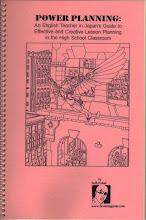
My dear friend Mary Jane said she had some old e-mails that we had exchanged that she wanted to give me.  She brought them today, just in time for me to post here.  They are from 1998, when Seth was working as an English teacher in the Oki Islands, Japan.  In the summer they had an English camp, which was called CHESS (which stands for Camp for Highschool English Students of Shimane (Prefecture)).  Seth designed activities that he knew would be fun, engaging, and help the students both learn English, and use the English they had learned.  


This is a view of what Seth was doing before he became a professional comic book illustrator, as well as a view of what the internet was like in its early days.  His website was on a platform called Geocities, that hosted many different websites.  

His students didn't know how to use internet tools very well, so the first page is full of definitions, the second page introduces the students to different things they can find on the web to help study English.  The third page is the opening to his own delightful website (alas, now no more, though the words--but not images--can be brought up on the Wayback Machine).  
Spend some time looking about in this room.  He has left here little bits of many parts of his life.  The two busts toward the right are of himself and best buddy Langdon.  There seems to be a dead guy over behind some stuff by the bookshelf; he would be the mystery game he designed for his students.  Books.  A lllama.  A cat.  Board games.  What else?

The fourth page is a little intro to his first real comic book, published by DC.  HAPPYDALE: Devils in the Desert.  


Thursday, January 30, 2014

Flowering Nose Day 2014

On Falling


A couple of small delights from Seth's oeuvre.
The above page from Happydale is interesting and maybe a bit foreboding, because the person they are talking about in the top panel is a picture of Seth himself, falling (on rollerblades) down the library steps. When Seth was in college he was an expert skater.   I have a photo of him on skates with a LOT of air underneath him. He used to jump over cars and the like.  He always wore knee and elbow pads, and since he didn't like to be hurt, he was always careful, no matter how high he jumped.   But he did do a lot of jumping, and maybe he learned to fall, and did like it.  Falling may have represented freedom to him.

And speaking of falling, below is page 9 from Seth's only Spiderman story.  In the story some knuckleheads are playing at being like Spiderman; they seem to be looking for the stupidest possible way to die.  This page shows one of them, whose safety rope has broken, being rescued in mid-fall by Spiderman himself.  The subject matter notwithstanding, it's an incredibly beautiful page, with the action at the top of the building at the top of the page, the middle at the middle of the page, and what is happening below at the bottom of the page.

On this Flowering Nose Day, let us use our energies to fall in love with each other and with all that is good, to encourage each other, and to do kindness with reckless abandon.  

Monday, November 16, 2009

inspiration from Seth: Happydale page 46


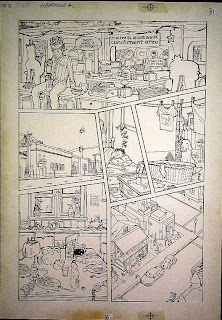
After Happydale was published, DC Comics sent Seth back his original drawings. He was so excited to have his own first comic book out in print. He was living here in San Diego at the time, and asked me if there was a page from Happydale that I would like. I went all through the pages, searching for an interesting one with a sort of human scale, that I could relate to. I am not sure really, why I chose this one. I guess I liked the guys hanging out at the local diner, doing regular things in their loopy Happydalian sort of way.

This picture hangs above my drawing table, where I look at it every day as I sit down to draw. It inspires me in many ways. First there is the fact that each of the characters is entirely recognizable, not only from his oddnesses, but from his facial features. I'd know Stretch's face even if he didn't have all the loose skin hanging from it, and Dino's even without the costume.
Next there is the fully realized setting. The decorative brickwork and the things on the shelf are only seen in a few panels, and have nothing to do with the story, but they are part of the whole ambience, and so Seth drew them in. It is as though this was a real place that Seth had been to, even if only in his imagination, and he could see in his mind's eye all the little bits that decorate the walls and shelves.
The other thing that inspires me is the realness of the facial and body language of the participants. The busboy clears the next table and someone lugs a box outside while our guys are bickering at their table and Dino is returning from the men's room. Sherman the waiter comes by with his tray and a half smile while Stretch works on his drink and Dino on his joint.
Seth doesn't point in an exaggerated way at any of these elements; they are just everyday parts of the page. The care and precision that has gone into all of it shows me just how very much I still have to learn. But the fact that Seth did learn it means that it can be done.
I am inspired daily.

Monday, September 7, 2009

In Seth's own words: What I don't do

Seth said, c.1998:
"I was terribly pleased to receive an e-mail from a fellow artist (an excellent one at that) about a year ago who asked me if I projected photographs and then traced them to make my art. 'Heavens No!' I exclaimed with a hint of glee. Langdon and I use virtually no references, and I would never use a projector. That would just be wrong. Well, not exactly no references. I have a stack of reference books for flowers and historical detailing and a few car magazines, but pictures are never drawn 'as is' from a photo, and by and large I use those books to spur my imagination rather than as a drawing crutch. I don't use references for figure work (besides the occasional contorted face in the mirror) because honestly it's easier for me to work from my head than from life (or a photo). Photos lie. A person looking at a photo believes that the image is correct because it's a photo, But for a twisted pose even tracing a photo exactly may not leave a convincing piece of line art. Choosing the pose is just as important as drawing it right. Likewise, my interiors are pieced together as I go along. My moral fiber works against me in regard to references. Since I was in high school I have been afraid to death of plagiarizing.

"I read once that if an artist copies a picture from a book he is plagiarizing that photographer. I became more and more conscious of this as I got older and it got to the point where I wouldn't even work from photos I had takcn myself, at least not without feeling guilty. Bizarre, isn't it? I think I have gotten over the more extreme elements of plagiarizing-phobia, but the spirit remains deeply embedded in my soul. But don't canonize me yet. The only things that come out of my pencil are things that have gone into my brain via one sense or another, and there are certain works of mine that might (on close examination) resemble certain styles and subject matter of other artists I adore (by accident or on purpose). I can't even be certain of all of them, but I look back and sometimes they become embarrassingly clear."

I am posting a couple of pictures that may illustrate both Seth's use of his own imagination, and his mastery of perspective, the kind of thing that may have given the unnamed artist the idea that he projected photos onto his pages and traced them. On top is page 31 from issue 2 of Happydale, and on the bottom is page 31 from Flash: Time Flies.
Over the years he kept a growing library of reference books, which he used--as he said--for flowers, cars, time periods, and so forth. But after Vertigo Pop Tokyo he pretty much stopped using references at all. He said that he really wanted to do it all from his imagination. Tomorrow I'll post a couple of pages from Fantastic Four that would have been done without references at all, from his own increasingly fertile brain.


Thursday, August 27, 2009

Influences on Seth, in his own words: Otomo


a couple of Seth images

Seth wrote this in 1998 or earlier, when he talked more about his work and methods. Later he let the work speak for itself more. I think he also didn't have the time to write so much about it; he spent more time DOING it.
a couple of Otomo images


But here is what he said about Otomo:
"Katsuhiro Otomo is definitely my idol whn it comes to angles and comic storytelling. Quite simply put, he is the best, bar none, at making a story exciting, subtle, and clear. His epic work Akira is the first book I pull off my shelves every time I feel a little empty in the idea department. Looking through his eyes suddenly makes me realize how two-dimensional and uninspired my thought processes are. It makes me rethink the obvious."

Seth's admiration for Otomo then, didn't cause him to copy at all, just to rethink his own pictures. So what he learned was about seeing an old idea from a new perspective, and making a story exciting, subtle, and clear. The two images (out of gazillions) that I chose from Otomo show all these things, and although you can't see the story from just these pictures, you can see that there certainly is one.
The two images of Seth's that I chose show how he also learned to look at a story with fresh eyes, and to find a point of view (both literal and figurative) that is clear and tells something about the story that the words alone are not saying.

Monday, June 8, 2009

Happydale 2 page 5

Some more of the people of Happydale.
On this page we meet Ralph and Ron Beck, jingle writers and sharpshooters, and the unnamed, obese receptionist at the sheriff's office.
I do not know how much of this is Andrew Dabb's brainchild and how much of it is Seth's. The original idea was Andrew's, but the two of them worked on it together, and the collaborative effort probably brought out the best in both of them, leading to, on this page: the sharpshooter team of one brother with no legs and the other with no arms, the fat receptionist who can't help but spread juicy secrets.
The next few pages introduce a delightfully bizarre group of Happydalians, people who are just part of the crowd in this town, but would be pariahs anywhere else.
We looked at the deputy sheriff HR's telephone the other day, which was a rotary one. Ralph and Ron have a (digital) kangaroo phone. They also have in their apartment an Easter Island statue, a pair of antlers (on the floor), a computer and copier, and Seth's favorite Moebius T-shirt. The receptionist has on her desk a small sign that says in alternate views, 1, and F. In Constance's living room there was also a small square on top of the TV with an F on it. Ah, now I get it: F is for Fisher. Also behind her on the wall is a most unlikely (except in Seth-land) large painting of a group of samurai.

Friday, June 5, 2009

Crowd scenes: Happydale and Big in Japan

Seth began Happydale in 1998, and drew Big in Japan in 2005. Those books mark the beginning and the end of his comic book career.

I thought it would be interesting to compare crowd scenes from the two books. It's not so much that his style evolved (though that was at least partly true), but he consciously tried to use a different style for each story. Both those factors account for the differences between these two pages.

Of course no place is quite like Happydale. Its citizens are, to a man, unique, goofy, charming, and eager to participate in whatever is going on. In the page from Happydale (issue 2, page 24) the crowd has gathered because someone has been shot and the perpetrators have locked themselves in a house and taken the residents as hostages. Each frame is drawn from the point of view of someone in the crowd; indeed, three out of five of them take the point of view of a midget. We are among the people, enjoying the festive atmosphere, and knowing that the police are fighting a losing battle trying to keep the crowd under control. There is a feel of unrestrained delight in this page that is part of the story, and also, I think, how Seth was feeling at the time.
The page from Big in Japan (issue 1 page 19) is less intimate, more designed, more elegant. The people in it are individuals; we see their unique hair and clothing styles, but we can't guess their personalities. They don't connect with us, the reader. That is reasonable in this context, because the people in the crowd are not the stars of this series as they were in Happydale: the monsters are the stars. And the monsters shine! They are the ones that are cute and ugly, unique, goofy, and even charming.

Thursday, June 4, 2009

Happydale 1 page 44

Another page full of great details.

Seth said in his notes for Doris and Fruit (in 2003) that he wanted to try & simplify his work.

Earlier he had said in an interview with Mike Jozic:
Geoff [Darrow]'s art often taunts the reader to try and spot everything on the page, and at some point I think it stops serving the story. Besides, I can't compete with Geoff for detail. He would beat me every time. Nevertheless I do hear comparisons to Geoff a lot....

I can't compare Seth's level of detail with Geoff Darrow's because I am not familiar with any comic book art really except Seth's. But it seems to me that in Happydale, the details give a sense of place, the way you know about someone when you go to their house and see what stuff they have on display on the walls and bookcases, as well as what they left sitting on the chairs and tables.

It's pretty delightful that HR uses a rotary phone. Seth liked to get the era right. Though Happydale takes place in the present, or in the not too distant past, the people who live there don't have much truck with the outside world, so HR is perfectly satisfied with his phone the way it is, as well as his record player in the corner.

Wednesday, June 3, 2009

Let's go to Happydale again

Seth's earlier work seems more ornate than his later work, more detailed. Compared to this, Big in Japan is quite severe, if I can use that term. Look at all the frou-frou in this house. Of course that's the look he wanted for this setting, but all of Happydale is so loaded with details that you can entertain yourself for hours going through the details in the background. He said himself that he never put in details the way Geoff Darrow did, with whom he was often compared, but he did like them.

Just in the furnishings and tchotchkes in this room, you've got a heavily carved grandfather clock, a table loaded with chess set, statue, candy dish, vases, and other things, then there is the floral wainscoting, and all the pictures seem to be in fancy frames. On top of the TV there are a video, its box (I think), a bowl of cookies, and the letter F. Eugene is lying on the floor surrounded by comic books and cookies. There are also various hard-to-read details in the extreme foreground. I can't tell what they are, but they make you believe that the room goes on farther, and that if you could stretch the edges out more, you would see more of the house. Seth makes you think that this is NOT a "picture"; it's more like a photo of a real place.

Tuesday, August 5, 2008

Happydale mini page 6

This is the last page of the mini comic Seth drew from his talks with Andrew Dabb.
If you were a publisher, would you give a chance to a newcomer who came to you with this work?
It is funny how different a turn the actual Happydale book took. I think they must have had a fully realized story that led in that direction, but just various ideas in this direction.

Sunday, August 3, 2008

Happydale mini page 5

The next page shows our stranger (who may or may not be the talent broker his card declares him to be) going out behind the convenience store to use the urinal. The middle small horizontal panel, showing only the threshold of the bathroom with the cigarette butt, is the sort of thing he liked to do when he was learning, but rarely used later on. It may just be that in stories written by someone else, he did not have the leisure to take page space to show such a small detail. Or it may be that he thought better of using his space that way.
An interesting part of this page is the size of the leaves on the bushes that are being trimmed by the alien. The bushes are seen in four separate panels, each from a different distance away. The leaves are quite a lot smaller where the bushes are farther away, and larger where the bushes are closer, and inbetween in the other panels. It's a small, maybe obvious, point, but it takes care and precision to draw them that way, especially as leaves are quite a nuisance to draw, and only a peripheral part of the story.

Saturday, August 2, 2008

Happydale mini page 4

It is easy to follow the action. Various angles show various elements of the scene, as a cameraman would show in a movie. And single small panels point out details that we should notice.

Friday, August 1, 2008

Happydale mini page 3

I don't need to go over the story. Since it has no words, no words are necessary.
But some of the details are worth a closer look. The top left panel has our stranger coming into the convenience store where he is at the front of the image, but with his back to us, so we are seeing what he is seeing: the layout of the store, and the clerk tending to a small boy. The store is fully realized, you could draw a map of it if you needed to, from the two large panels. The second of three upper right panels has him peering into a cooler of soda bottles (all with lift-off caps!), and the third of those three shows him a second or two later, but from a top shelf a little ways away.
These themes: varying points of view and completeness of the setting, are things that Seth continued to use and develop throughout his work. It is interesting that in his very earliest work they were part of his toolbag. He applied both of these consciously to his work: it was what he admired in illustration work, and so he wanted his own work to show as well.

Wednesday, July 30, 2008

Happydale mini page 2

This mini comic is wordless, as Seth either didn't want to or didn't know how to do the word balloons. Or he just wanted to show how well he could tell a story without words.
So we have a stranger wandering into Happydale, with its collection of characters, and stopping for gas at the Pit Stop, where he goes inside to pay.
It is a pleasure to see work that is not only Seth's art, but where Seth was free to put in his own details: the goats that hang out at the gas station, the old guy (I have forgotten his name) in his bathrobe and mouse slippers sitting in front of the convenience store reading Beowulf, the sign in the window that says, "We have worms", and the partial details that show that this town is fully realized even though we can't see it all.

Monday, July 28, 2008

Happydale images


These are some of the first pieces Seth produced for Happydale. They were part of the original promotional material that he pitched to the publishers. I am not sure if he even knew what the content of the story was going to be when he drew these images. He and Andrew had the idea for this town where all the citizens were outcasts in some quirky way or another, and the Devils in the Desert story they completed was only one of the many stories that they were going to set there. They thought there would be many more.
I will try to find the original mini comic that was what he showed to the publishers at the outset. If I can find it I will post it here. It is quite different from the story that Vertigo published. At least one of the images from it is on his website here, of a three-headed boy (or boys) sitting on the ground reading a comic book.

Saturday, July 26, 2008

Happydale #1 cover

This is the wraparound cover for Happydale, part one. It is sort of an introduction to the people of Happydale, each of them doing whatever they do. They seem to be looking at something
behind us, and up in the air somewhere. Whatever it is, it is strange, and they don't like it. Seth himself is in the middle of this page, looking the most horrified of anyone.
This series was inked on regular Strathmore 3-ply artboard, not on official DC paper. Seth researched the format and on his own made his work fit. Maybe that is not so unusual, except that I suspect not many DC comics are done that way. The paper size is a little bigger than the usual, because he gave himself bigger margins. Also the word balloons are pasted on with rubber cement, and many of them are coming off. That way of putting in the lettering changed on Seth's watch. Batman was the first of his comic books to come back to him with no lettering on the pages: it was all done digitally. That must have been about 2003 or so. Before that they pasted the words in laboriously by hand.

Thursday, July 24, 2008

Happydale #2 cover

A great Seth Fisher crowd scene.
One of the things that is most characteristic of Seth's work, and most appealing, is that no matter how great the population of a scene, each person has a home life, a personality, and his or her own needs, interests, and quirks. Nowhere is this more true than in Happydale, of course, where the citizens are notable for their eccentricities.
In this scene, in Happydale where everyone knows everyone else, someone has been shot, the perpetrator is holding a few people hostage, and of course everyone else wants to see. It is the biggest, most interesting thing that has happened in their little burg in ages, and nobody wants to be left out of the action.
You could examine each person in the crowd, and you would know a little something about each one. That is Seth's eye, and it is also how he saw people in life. There are no throwaway people; everyone has a story. Everyone matters.

Monday, July 21, 2008

Happydale #1 page 24

This amazing page shows a couple of scenes from everyday life in Happydale. Sadie is taking a walk around town, and she passes these Happydalians doing what they do. The top image shows someone roller blading down the library steps, careening wildly and sure to land in a heap at the bottom. That person is Seth himself, wearing knee and elbow guards, as he always did. Dino (in the dinosaur suit) is watching and saying, "He's always falling. He likes to fall, I think." Stretch agrees.
One of the things that Seth taught me is that the action that the reader is supposed to be watching does not have to take place in the foreground of the picture. There can be other things larger and pictorially more prominent, which gives the scene more of a sense of place. The statue with someone resting beside it surrounded by birds (even a dodo), all these details in the foreground give us a flavor of life in Happydale.
In the bottom panel, Sadie passes a group of people doing an aerobics class. The teacher looks like the type of fit young woman who usually teaches aerobics. The students are much more eccentric. I won't take away the pleasure of discovery by describing them, but they all seem to be doing their best to keep up. Our view of this scene is the omniscient sort of bird's eye view. That view point shows everyone as equal in importance, and so Sadie--though she feels like an outsider--takes her place in the community in this panel.

Saturday, July 19, 2008

Happydale #2 page 25

I found a few scans of Happydale pages that Seth had hoped to sell, probably quite a long time ago. I don't think he was pushing Happydale after his more broad based comic books were published.
But if the artwork for this series is not so polished as his later work, it still has the varying points of view, the love of detail, and the compassion for each of the inhabitants of his pages that characterized his later work as well. It also has the quirky view of the world that is probably what will be most remembered about Seth.
In this page, the citizens of Happydale are all gathered around waiting to see what will happen to the miscreants who have interrupted their idyllic lives. Everyone has his or her own eccentric ideas about what to do next. We get close-ups of the two in the upper right with no legs and no arms respectively, of HR with his third eye almost visible under his bandana, and the deputy sheriff Poe, who has initials carved into his forehead. We have met each of these people already and know them well enough to care about them. The large center panel shows Poe trying somewhat vainly to put the show in order, and the bottom right panel shows just how much in vain his orders are.

Wednesday, July 16, 2008

Happydale #1 page 15

I haven't written much about Happydale. It was Seth's first comic book. Did I tell how it came about?
Seth was in Japan teaching English, but always working on his art. He met Andrew Dabb on the internet. But I'll just post what Andrew himself wrote about Seth after he heard that Seth had died.
These are Andrew's words:
I first met Seth in 1996 online via Hydraski’s Cesspool, a website that showcased aspiring comic creators' work. He and I started talking, got along well, and decided to do a book together. That book would eventually come out through Vertigo as Happydale: Devils in the Desert.
A little backstory: Based on an initial 8 page short and a basic pitch, Happydale was first accepted by Jim Valentino’s Non-Line (a division of Image which at that time was publishing indy stuff, Brian Wood’s Channel Zero being the most prominent)…which promptly collapsed a few months after we’d signed our contracts. But instead of giving up, or taking our little 8 page pitch around to publishers again (my plan), Seth decided to quit his job, draw all of Happydale (130+ pages) and try to sell it as a complete package. The end result was that a year later we had a publishing deal at Vertigo based pretty much entirely on Seth’s art and his incredibly cool, gracious personality. Not to mention his work ethic; for one panel in Happydale, which showed the undercarriage of a truck, I can remember him telling me how he had actually spent a few hours laying under a truck and sketching. It was that kind of dedication and eye for detail that made Seth stand out.
After Happydale, Seth went on to bigger and better things that allowed him to use his myriad of skills, like Green Lantern: Willworld, and Vertigo Pop: Tokyo. Books which firmly established him, in my opinion, as one of the ten best comic book artists working today. The fact that we won’t get to see what he would have done 5 or 10 years from now is a huge loss. Comics have very few visionaries; Seth was one and to lose him is a blow to the entire medium. In time, I think more and more people will realize that.
Seth was a good friend, an amazing artist, and one of the most charismatic, upbeat, positive people I’ve ever known. We hadn’t talked much in the last few years, but every time we did I enjoyed it immensely. In a very real way, I owe him my career, and so to see him gone at such a young age is a blow on a level I can’t quite describe in words. I can only offer my condolences to his family, especially his wife and young son, and hope that Seth will be remembered as the truly unique talent he so obviously was.